Waste is the cost a busy kitchen stops seeing. It never appears as a line on the menu, and it rarely shows up in a way that prompts a decision. It sits in the dessert fridge on a quiet Tuesday, in the tray of product made for a weekend that has already gone, in the slice that goes in the bin at close because it will not hold another day.
The frustrating part is that you paid for all of it. The ingredients, the labour and the storage were spent before the customer ever chose whether to buy. Made-fresh and short-life dessert forces you to commit that cost days ahead of the demand it is chasing, and then wear the gap when the two do not line up.
That gap is where wholesale desserts in a frozen format do their least glamorous and most valuable work. The case is simple once you see it: a product that can wait for demand stops turning your forecast into your waste. Here is how the maths actually changes.
Why in-house dessert forces you to guess
A dessert with a short shelf life has to be made to a forecast. You decide on Thursday how many covers Saturday will bring, prep to that number, and hope the weather, the football and the walk-in traffic agree with you.
They often do not. Over-prep and the surplus is waste. Under-prep and you have empty cabinet space during your best trading hours, which is lost sale rather than saved cost. Either way the forecast, not the customer, is setting your output. The tighter a product’s life, the less room you have to be wrong, and dessert is usually one of the tightest-life sections in the building. It is exactly the section where frozen desserts remove the guess.
What a frozen format changes
The whole equation shifts when the product can wait for the demand instead of the other way around.
Frozen desserts are built to be held and then brought out to meet real trade, not a prediction of it. You defrost to demand. A slow week no longer means a fridge full of product ageing toward the bin, because what you have not defrosted is still good stock rather than tomorrow’s waste. A sudden busy run no longer means empty shelves, because the next tray is in the freezer, not something you needed to have baked on Wednesday.
This is the practical case for wholesale desserts over made-fresh across the bulk of a menu. You are not buying a different dessert. You are buying the ability to match supply to demand at the point of sale, which is the only point where either of them is real.
Shelf life as a planning tool, not just a number
Shelf life reads like a technical spec on a product sheet. In a kitchen it is a planning tool, and it is one of the most useful ones you have.
Priestley’s product carries a shelf life of 364 days frozen plus. Read that as freedom to plan rather than a date to watch. A long, dependable frozen life lets you hold a range without holding risk, order to a delivery schedule that suits your kitchen, and carry variety you could never justify making fresh for the numbers you actually sell. Foodservice desserts designed around that kind of shelf life are the difference between stocking to demand and stocking to hope.
It also protects you across the parts of the year that punish a fresh-only model. Quiet January and the pre-Christmas surge are the same problem in opposite directions, and both are easier to hold with frozen desserts that keep. This is the planning headroom wholesale desserts give you that a made-fresh section never can.
Portion-ready formats and the counter you are not using
Frozen is not only a defence against waste. It opens sales a plated dessert offer cannot reach.
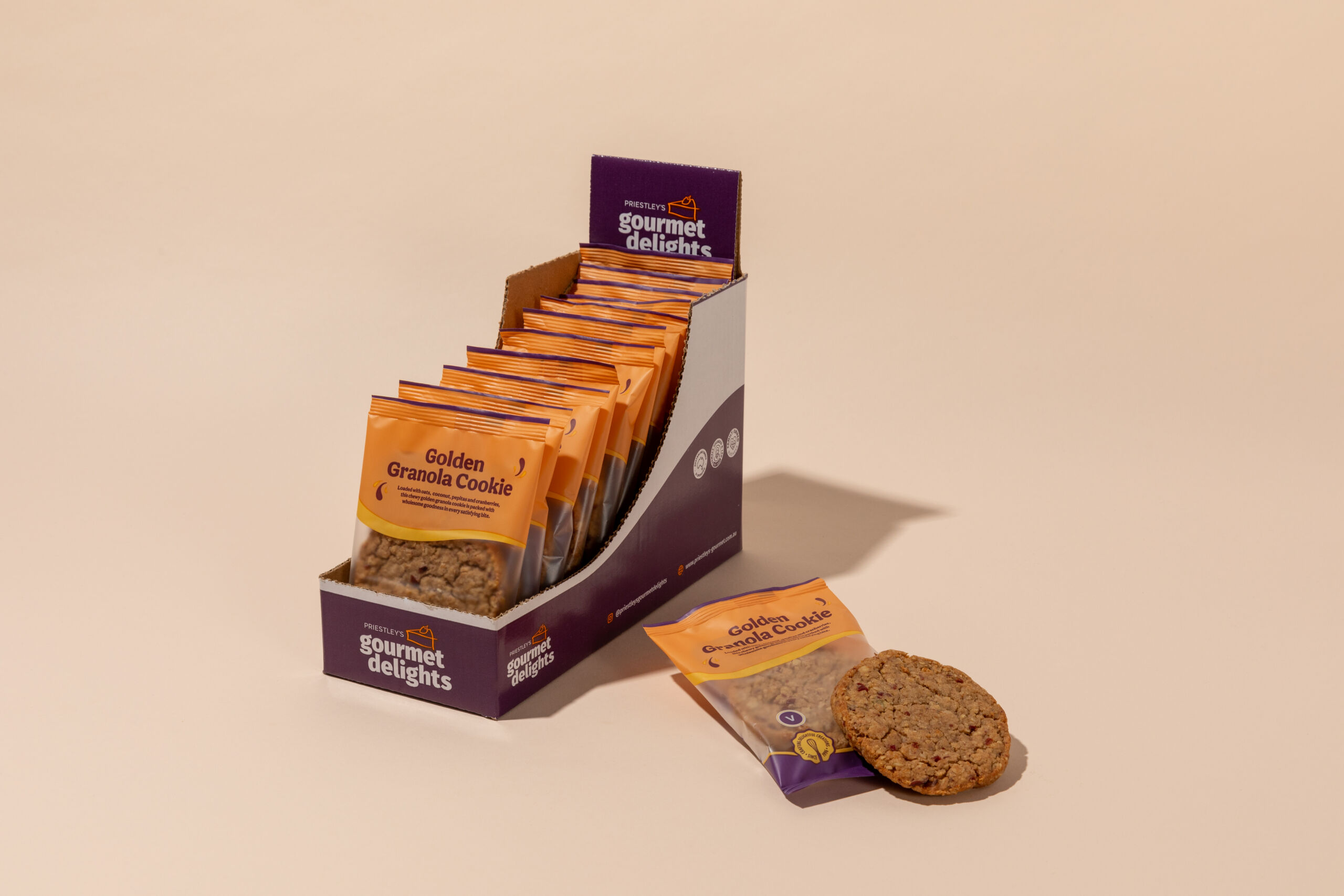
Individually wrapped Grab & Go cookies and portion-ready foodservice desserts turn counter and takeaway space into revenue without adding a prep hour or a waste risk. Each unit is sold as it sells, and what does not sell today is not spoiled tomorrow. For a cabinet, a drive-through, a convenience fixture or a catering run, that is growth with the guessing taken out of it. Portion-ready cakes, cheesecakes and slices do the same job inside table service, where every serve is the yield you costed and none of it rests on a forecast. This is where wholesale desserts stop being a cost line and start being a growth one.
How to trial it without overhauling the menu
You do not need to convert the whole section to find out whether this works for your venue. Start where the pain is.
Take the two desserts that waste the most, the ones you regularly bin or bake to a nervous guess, and move only those to a frozen, defrost-to-demand line for a month. Track three things: waste against the same month last cycle, how often you ran out during peak, and whether the section held its margin. Keep any signature dessert your regulars come back for. Most venues have one, and it is usually worth the effort it takes.
If the numbers hold, extend the frozen desserts across the slower-moving rest of the section and keep the fresh work for where it earns its place. If they do not, you have lost a month and learned something specific about your own trade. Either way you have measured it, which is more than most venues ever do with foodservice desserts on the section.
Talk to us about your venue
Priestley’s Gourmet Delights has supplied the Australian foodservice industry since 1996, from Queensland and nationally. The range covers premium cakes, cheesecakes, pavlova, Christmas puddings, seasonal and savoury bakery, and the frozen, portion-ready formats built for exactly this problem.
We are Australian owned and operated, and we work trade-to-trade. Tell us where your waste is going, how many covers you run and how your week rises and falls, and we will point you at the wholesale desserts that let you defrost to demand and keep the margin you have already paid for. Talk to the Priestley’s team about the frozen range for your site.